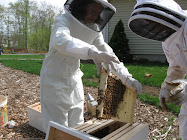
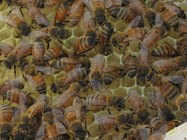
There is something miraculous about approaching spring. I just walked outside to pick up the newspaper and experienced 49 degrees at 6:45am -- which after a full season of winter, felt like a balmy 65 degree morning. That all of the planets in our solar system hang in space spinning in time on their own axis and around our sun changing our weather and seasons ... miraculous. Just like all of the minuet details that must come together to conceive, grow and give birth to a child ... it's miraculous. Welcome spring ... come quickly! And, thank you Lord for this small glimpse of what's to come.
Tuesday, March 4, 2008


Tuesday, February 26, 2008
Winter Farmer's Market
 So, we went to the Winter Farmer's Market on Saturday. I'd forgotten about it, so we got there late and missed the greens and bokchoy but here is a sampling of the things we did buy. How fun! Again it's on Saturdays from 12 to 3 in the AS220 Building, 115 Empire Street in Providence. They had fabulous music and in the room next door is a fabulous restaurant I'd never been to ... where have I been??? Taqueria Pacifica opens at 12 noon and they serve Tex-Mex foods and breakfast Tex-Mex foods on Saturday. They use a lot of local foods including local eggs. Very yummy, hip, low key and artsy.
Vitamin D
Last fall I read that 80 to 90 percent of people are vitamin D deficient. After suffering as I usually do from winter doldrums -- particularly by the time February and March roll around I was researching the idea of getting one of those light boxes to relieve the slumps. Then I read that a large majority of people are vitamin deficient and that the recommended daily amount of Vitamin D was too low. Also, when milk - fortified w/ Vitamin D - was tested they found that the Vitamin D levels were depleted sometimes to more than half the amount. So, this winter, I've added Vitamin D to my daily vitamins and don't you know I have had NO WINTER DOLDRUMS ... in spite of my lowering the temperature of our home to icebox levels (ok, I'm exaggerating). Isn't that exciting?! So, for any of you who live in areas where you hardly expose your skin to the light of day from November to April do some research and consider taking some Vitamin D. I've been taking 800 IU of Vitamin D daily. Some recommend 1000 IU. Anyway, it's worth some research -- I for one can tell you it's made a huge difference in my life this winter! Check it out.
Enjoy!
Monday, February 25, 2008
Oil Bill
Ok guys ... I'm a little demoralized. I just received our oil bill. If you remember, I reprogrammed our thermostats cutting down our night time temps drastically and lowered our day time temps from 68 degrees to 66 degrees. I also had our furnace cleaned and tuned. It's been a major stretch for me (I'm always cold) often dressed with wool sweater, wool socks, Uggs, wool hat, and sometimes even a scarf ... INDOORS! Well, accounting for the two extra days in this months bill versus last months and the slight increase in oil ... if the oil price had stayed the same I would have saved a whooping 95 cents a day!! However, the oil price went up, and this month I ended up paying $22.67 MORE. 95 cents may sound encouraging to you, however, let me tell you, there were some days I would have gladly payed $2 a day just to take off the hat and scarf! Help! What do you think?! Should I cave and go back up 2 degrees? I guess ultimately, if oil prices had stayed the same, I would have saved $29.45. That's pretty good. Right??
Saturday, February 23, 2008
In Memory of "Bobby D"
"Bobby D" as we called him, went home to be with the Lord last week. His life was filled with peaks and valleys, but his heart was dear and his eyes were twinkling. One of his loves and gifts was his effortless ability to whip up something fabulous in the kitchen. After an abundant tomato harvest one year we happened to have a church potluck at our house. Bobby D had been simmering his "gravy" (Italian red sauce) all day, and brought it over in a crock pot. Wow. It was fabulous. I was over ten years younger and had never made my own sauce ... and if I had, it wouldn't have tasted that good! With my enormous stock pile of fresh tomatoes in mind, a few days later, I called Bobby D up over the phone and begged him to tell me how he did it. Generous man that he was, he shared it with me. Now, Bobby D was the type of cook to throw stuff in without measuring so know that this is just the version that he was able to call out to me on the phone. I made it not to long ago for family night, and let me tell you, it got rave reviews.
.
So, In His Memory ... Here is Bobby D's Gravy.
.
Cover bottom of large pan with extra virgin olive oil
6 - 8 cloves garlic crushed
1 1/2 medium or 2 small yellow onions chopped
Cook garlic and onion over med-low heat.
Add 3-4 pork chops with bone to pan.
Simmer for 1 hour.
Add 1/2 of 24oz can of crushed tomatoes plus a little water.
Nice big handful of fresh basil chopped.
Black Pepper & Salt (he didn't mention it, but I added crushed red pepper too ... I like it hot)
Simmer 3 hours.
De-bone pork chops - discard bones.
Remove pork from pan.
Add remaining 1/2 of 24oz can of tomatoes.
Puree sauce with Cuisinart or one of those handy-dandy wand soup pureer thing-a-ma-jigs.
Put pork back in. (I smashed the pork with fork to make the pieces smaller)
Add remaining cans of tomatoes (5 - 24oz cans crushed tomatoes)
Cook for at least another hour.
If bitter add a dash of sugar or cook with a carrot.
Add more water to get proper consistency -- ("gravy" is quite runny)
.
Enjoy . . . And remember a man who loved people, cooking, sushi, gospel music with a good beat, "gabbing", his gravy, "his girls", and the Lord.
.
"Through the Lord's mercies we are not consumed, because His compassions fail not. They are new every morning; great is Your faithfulness. "The Lord is my portion," says my soul, "Therefore I hope in Him!" "Lamentations 3:22-24
Wednesday, February 20, 2008
R.I. Slow Food, CSA's and Phosphates
Slow Food Nation
Support local farmers' efforts to become part of the Slow Food Nation movement. Two local Providence Restaurant owners / chefs that invest in local foods Farmstead and New Rivers are holding The Rhode Island Aquaculture Dinner on Sunday, March 30 at New Rivers. The cost for the five-course dinner is $75 and includes mollusks, bivalves and more. The money from the dinner sill send Rhode Island farmers to the Slow Food Nation show in San Francisco. Call New Rivers at 401-751-0350.
"Slow Food Nation inspires and empowers Americans to build a food system that is good, clean and fair.The world's most pressing questions regarding health, culture, the environment, education, social justice and the global economy are all deeply connected to the food we eat and how it is produced. Slow Food Nation is an event at the center of a movement with national impact and global implications. It will engage tens of thousands of attendees in learning how everyday choices affect our wellbeing, our culture and the health of the planet. The event will be held from August 29 to September 1, 2008 in San Francisco, and will bring hundreds of farmers and food artisans from across the country to present an extraordinary range of foods and preparation techniques. It will offer activities for all ages, including food, music, talks, forums, workshops, films and exhibits, all highlighting food that supports an agricultural system that is good, clean and fair."
CSA's
Have you heard of CSA's? No, not CFL's the light bulbs, not CPA's the number crunchers ... CSA Community Supported Agriculture. You basically "sign-up" with a local farm to buy a "share" of the local food grown at that farm. This way you are supporting local farms and living a greener lifestyle by purchasing local foods as they are ready in your local area -- as oppossed to paying for food that's been motored to your grocery store all the way from South America. To connect to a local farm near you go to www.localharvest.org . If you are in the greater Providence, Rhode Island area, or close to Little Compton, Rhode Island there is a wonderful organic and I.P.M. CSA that is worth checking out. www.wishingstonefarm.com You can pick up your "share" from Wishing Stone in Providence or in Little Compton right at the farm (which incidentally is just down the street from our tiny summer place). Wishing Stone allows you to pick what you want from what they have available as opposed to giving you a pre-packed box or bag. Different farms handle distribution differently. Don't delay though, because shares sell out.
Phosphates
Phosphates. Just what are they? Have you seen the labeling on cleaning products boldly claiming "contains no phosphates". Well, that got me to thinking, What on earth are they? Why are they bad for the environment? and What HAS phosphates IN them? Well, the short answer is:
But, it's more complicated than that. About a month ago I did some research online and copied a few articles to a file ... but regretably didn't record where I got them from. So, sorry I'm not to be able to reference these. However, for what it's worth, here are more in depth explainations:
From Article 1:
Support local farmers' efforts to become part of the Slow Food Nation movement. Two local Providence Restaurant owners / chefs that invest in local foods Farmstead and New Rivers are holding The Rhode Island Aquaculture Dinner on Sunday, March 30 at New Rivers. The cost for the five-course dinner is $75 and includes mollusks, bivalves and more. The money from the dinner sill send Rhode Island farmers to the Slow Food Nation show in San Francisco. Call New Rivers at 401-751-0350.
"Slow Food Nation inspires and empowers Americans to build a food system that is good, clean and fair.The world's most pressing questions regarding health, culture, the environment, education, social justice and the global economy are all deeply connected to the food we eat and how it is produced. Slow Food Nation is an event at the center of a movement with national impact and global implications. It will engage tens of thousands of attendees in learning how everyday choices affect our wellbeing, our culture and the health of the planet. The event will be held from August 29 to September 1, 2008 in San Francisco, and will bring hundreds of farmers and food artisans from across the country to present an extraordinary range of foods and preparation techniques. It will offer activities for all ages, including food, music, talks, forums, workshops, films and exhibits, all highlighting food that supports an agricultural system that is good, clean and fair."
CSA's
Have you heard of CSA's? No, not CFL's the light bulbs, not CPA's the number crunchers ... CSA Community Supported Agriculture. You basically "sign-up" with a local farm to buy a "share" of the local food grown at that farm. This way you are supporting local farms and living a greener lifestyle by purchasing local foods as they are ready in your local area -- as oppossed to paying for food that's been motored to your grocery store all the way from South America. To connect to a local farm near you go to www.localharvest.org . If you are in the greater Providence, Rhode Island area, or close to Little Compton, Rhode Island there is a wonderful organic and I.P.M. CSA that is worth checking out. www.wishingstonefarm.com You can pick up your "share" from Wishing Stone in Providence or in Little Compton right at the farm (which incidentally is just down the street from our tiny summer place). Wishing Stone allows you to pick what you want from what they have available as opposed to giving you a pre-packed box or bag. Different farms handle distribution differently. Don't delay though, because shares sell out.
Phosphates
Phosphates. Just what are they? Have you seen the labeling on cleaning products boldly claiming "contains no phosphates". Well, that got me to thinking, What on earth are they? Why are they bad for the environment? and What HAS phosphates IN them? Well, the short answer is:
- A) Dishwasher Detergent is the most common place you will find phosphates in your home. FYI: After a few trials, the best most effective phosphate-free dishwasher detergent I've used is Seventh Generation.
- B) Phosphates basically act like a fertilizer that when they enter water tables, rivers, lakes ... etc. they over produce algae that rob the water of all of the oxygen then of course fish and other aquatic organisms die.
- C) It's serious enough that when the government recognized the problems that phosphates were causing, local governments started putting limits on the amount of phosphates allowed in products. In Washington State for example, by 2010 phosphate levels cannot exceed 0.5 percent.
But, it's more complicated than that. About a month ago I did some research online and copied a few articles to a file ... but regretably didn't record where I got them from. So, sorry I'm not to be able to reference these. However, for what it's worth, here are more in depth explainations:
From Article 1:
"Phosphates enter waterways from human and animal waste, phosphorus rich bedrock, laundry, cleaning, industrial effluents, and fertilizer runoff. These phosphates become detrimental when they over fertilize aquatic plants and cause stepped up eutrophication.
Eutrophication is the natural aging process of a body of water such as a bay or lake. This process results from the increase of nutrients within the body of water which, in turn, create plant growth. The plants die more quickly than they can be decomposed. This dead plant matter builds up and together with sediment entering the water, fills in the bed of the bay or lake making it more shallow. Normally this process takes thousands of years.
Cultural eutrophication is an unnatural speeding up of this process because of man's addition of phosphates, nitrogen, and sediment to the water. Bodies of water are being aged at a much faster rate than geological forces can create new ones.
In testing for cultural eutrophication, one would expect to find an algal bloom or scum on the water accompanied by a fishy smell to the water and a low dissolved oxygen content. Do not expect to find a high phosphate reading if the algae is already blooming, as the phosphates will already be in the algae, not in the water. The algae bloom should start where running water enters the lake or bay, so test the water before the area where the bloom begins for high phosphate and nitrate levels.
Monitors should be aware that there are different kinds of phosphates in the water, but a total phosphate-phosphorous reading is all that is needed to calculate the water quality. Use the chart below to rate your water sample:
How phosphorous affects aquatic life
If too much phosphate is present in the water the algae and weeds will grow rapidly, may choke the waterway, and use up large amounts of precious oxygen (in the absence of photosynthesis and as the algae and plants die and are consumed by aerobic bacteria.) The result may be the death of many fish and aquatic organisms.
Environmental Impact: Rainfall can cause varying amounts of phosphates to wash from farm soils into nearby waterways. Phosphate will stimulate the growth of plankton and aquatic plants which provide food for fish. This may cause an increase in the fish population and improve the overall water quality. However, if an excess of phosphate enters the waterway, algae and aquatic plants will grow wildly, choke up the waterway and use up large amounts of oxygen. This condition is known as eutrophication or over-fertilization of receiving waters. This rapid growth of aquatic vegetation eventually dies and as it decays it uses up oxygen. This process in turn causes the death of aquatic life because of the lowering of dissolved oxygen levels. Phosphates are not toxic to people or animals unless they are present in very high levels. Digestive problems could occur from extremely high levels of phosphate."
Eutrophication is the natural aging process of a body of water such as a bay or lake. This process results from the increase of nutrients within the body of water which, in turn, create plant growth. The plants die more quickly than they can be decomposed. This dead plant matter builds up and together with sediment entering the water, fills in the bed of the bay or lake making it more shallow. Normally this process takes thousands of years.
Cultural eutrophication is an unnatural speeding up of this process because of man's addition of phosphates, nitrogen, and sediment to the water. Bodies of water are being aged at a much faster rate than geological forces can create new ones.
In testing for cultural eutrophication, one would expect to find an algal bloom or scum on the water accompanied by a fishy smell to the water and a low dissolved oxygen content. Do not expect to find a high phosphate reading if the algae is already blooming, as the phosphates will already be in the algae, not in the water. The algae bloom should start where running water enters the lake or bay, so test the water before the area where the bloom begins for high phosphate and nitrate levels.
Monitors should be aware that there are different kinds of phosphates in the water, but a total phosphate-phosphorous reading is all that is needed to calculate the water quality. Use the chart below to rate your water sample:
How phosphorous affects aquatic life
If too much phosphate is present in the water the algae and weeds will grow rapidly, may choke the waterway, and use up large amounts of precious oxygen (in the absence of photosynthesis and as the algae and plants die and are consumed by aerobic bacteria.) The result may be the death of many fish and aquatic organisms.
Environmental Impact: Rainfall can cause varying amounts of phosphates to wash from farm soils into nearby waterways. Phosphate will stimulate the growth of plankton and aquatic plants which provide food for fish. This may cause an increase in the fish population and improve the overall water quality. However, if an excess of phosphate enters the waterway, algae and aquatic plants will grow wildly, choke up the waterway and use up large amounts of oxygen. This condition is known as eutrophication or over-fertilization of receiving waters. This rapid growth of aquatic vegetation eventually dies and as it decays it uses up oxygen. This process in turn causes the death of aquatic life because of the lowering of dissolved oxygen levels. Phosphates are not toxic to people or animals unless they are present in very high levels. Digestive problems could occur from extremely high levels of phosphate."
From Article 2:
"Back in the 1970s, the U.S. government recognized the problem of phosphorus pollution -- it can cause massive algal blooms in waterways that screw with ecosystems by robbing the water and aquatic life of all-important oxygen -- and started trying to come up with alternatives. Meanwhile, states and localities became more and more aware of the undesirable effects of phosphorus and began acting on their own to limit or restrict its use in laundry detergents, the first places being five cities in Illinois in 1971. (Way to go, Illinoisans!) By the 1990s, enough states and localities had limited or restricted laundry-detergent phosphates that detergent companies saw the writing on the machine and decided to voluntarily phase them out in all domestic formulations, which was done by the mid-1990s.
The main reason dishwashing-detergent phosphates didn't get the same treatment was that the best alternatives, enzymes, were neither common nor cheap even as late as the early '90s. There was also the influence of heavy lobbying by detergent makers and phosphate cheerleaders to keep them in. And so phosphates remain in many detergents at varying levels, even though they don't need to be there.
There are plenty of eco-friendly, phosphate-free alternatives that wash dishes just as well or better than phosphate-laden ones. And you probably won't be surprised to learn that mainstream, big-name detergents have lots of other suspect ingredients that are derived from petroleum and aren't so environmentally benign, a main one being artificial fragrances. So it's best to use one of the eco-brands anyway, and any eco-brand worth its eco-label will be phosphate- and chlorine-free.
Some states and localities are starting to severely limit or ban phosphates in dishwasher detergent too. My spiffy home state of Washington signed new rules into law this year that will keep the phosphorus content in dishwashing detergent to 0.5 percent beginning in 2010. It's a significant cut, since detergents now contain up to 9 percent."
The main reason dishwashing-detergent phosphates didn't get the same treatment was that the best alternatives, enzymes, were neither common nor cheap even as late as the early '90s. There was also the influence of heavy lobbying by detergent makers and phosphate cheerleaders to keep them in. And so phosphates remain in many detergents at varying levels, even though they don't need to be there.
There are plenty of eco-friendly, phosphate-free alternatives that wash dishes just as well or better than phosphate-laden ones. And you probably won't be surprised to learn that mainstream, big-name detergents have lots of other suspect ingredients that are derived from petroleum and aren't so environmentally benign, a main one being artificial fragrances. So it's best to use one of the eco-brands anyway, and any eco-brand worth its eco-label will be phosphate- and chlorine-free.
Some states and localities are starting to severely limit or ban phosphates in dishwasher detergent too. My spiffy home state of Washington signed new rules into law this year that will keep the phosphorus content in dishwashing detergent to 0.5 percent beginning in 2010. It's a significant cut, since detergents now contain up to 9 percent."
Hope you find this interesting and informative. Enjoy!
Monday, February 18, 2008
Skiing Again


We went skiing again this weekend. Benjamin is working on his parallel skiing and Ripley can ski down the majic carpet tiny trail by himself ... with occassional correction. Victor and I spent most of our time chasing Ripley on the majic carpet trail, so regretably we don't have ONE picture of Benjamin. Regret. Ripley's advetures however, were well documented . . .
Friday, February 15, 2008
Local Food - Winter Farmers Market!
Hey this is exciting stuff. I read in the paper the other day that Rhode Island farmers are having such a call from local restaurants and even schools for local produce over the winter months that they have decided to hold Farmers Markets! Isn't that fabulous?! Here is the info for those of you in the Providence area.
Saturdays from 12 noon to 3 pm, Inside AS220, 115 Empire Street, Providence
Here is the website: www.farmfreshri.org
A bit about the Providence Wintertime Farmers' MarketLocal food all winter long. The chickens are still laying eggs. The salad greens are so leafy and crisp. The onions and garlic are packing spice. The apples and squashes are getting sweeter by the day. Join us for the start of another 365 days of local food. Chefs and eaters, one and all, come enjoy all that grows in Rhode Island year-round! Plus aprons, bowls, cups and calendars by Providence artists for your culinary-inclined loved ones. And hot coffee and brunch next door at Taqueria Pacifica. ALL WINTER LONG: Lettuces, arugula, bok choi, kale, collards, cabbage, chard, apples, cider, potatoes, sweet potatoes, onions, leeks, garlic, radishes, chilis, fresh herbs, beets, carrots, parsnips, turnips, winter squash, oysters, beef, pork, Narragansett Creamery cheese, eggs, honey, maple syrup DECEMBER: Wreaths and trees, broccoli, cauliflower MARCH: maple syrup MAY: asparagus ALSO from non-farm RI producers: jams, jellies, tortillas, johnnycake mix, chocolates, fair-trade coffee by the pound, gifts for your favorite foodie** More farmers and vendors to be announced...**
Isn't this exciting??!
Remember, eating locally is GREEN -- saving all of the energy it takes to ship your food all the way from California ... or worse, China or South America!
Enjoy!
Saturdays from 12 noon to 3 pm, Inside AS220, 115 Empire Street, Providence
Here is the website: www.farmfreshri.org
A bit about the Providence Wintertime Farmers' MarketLocal food all winter long. The chickens are still laying eggs. The salad greens are so leafy and crisp. The onions and garlic are packing spice. The apples and squashes are getting sweeter by the day. Join us for the start of another 365 days of local food. Chefs and eaters, one and all, come enjoy all that grows in Rhode Island year-round! Plus aprons, bowls, cups and calendars by Providence artists for your culinary-inclined loved ones. And hot coffee and brunch next door at Taqueria Pacifica. ALL WINTER LONG: Lettuces, arugula, bok choi, kale, collards, cabbage, chard, apples, cider, potatoes, sweet potatoes, onions, leeks, garlic, radishes, chilis, fresh herbs, beets, carrots, parsnips, turnips, winter squash, oysters, beef, pork, Narragansett Creamery cheese, eggs, honey, maple syrup DECEMBER: Wreaths and trees, broccoli, cauliflower MARCH: maple syrup MAY: asparagus ALSO from non-farm RI producers: jams, jellies, tortillas, johnnycake mix, chocolates, fair-trade coffee by the pound, gifts for your favorite foodie** More farmers and vendors to be announced...**
Isn't this exciting??!
Remember, eating locally is GREEN -- saving all of the energy it takes to ship your food all the way from California ... or worse, China or South America!
Enjoy!
Thursday, February 14, 2008
Happy Valentine's Day!

Here are my Valentine's Spitzbubien Cookes! For recipe look under "Cookies", "Family Recipes", or "Recipes". Yum!
Tuesday, February 12, 2008
Fruit Trees, Benjamin and Whole Foods
Well, over the weekend I attended a seminar given by the University of Massachusetts Amherst about growing apples organically. We live in a rural development and are regretably restricted from having chickens. When I started lamenting about where we had chosen to settle, I realized that with all of the land we have, what is to stop me from enlarging my garden space and planting some fruit trees? I've already met with a man we've used before to do various plantings to see about enlarging the number of raised beds we have and creating a mixed fruit tree "petite" orchard including apples, peaches, pears, cherries and blueberries that works with our "rural development" neighborhood. Fruit trees are known for being challenging - particularly if you are growing them organically. So, this is what the seminar was all about. Exciting! I'll keep you posted.
Just a word about Benjamin ... I've been meaning to write this for awhile now ...
Do you know that my eight year old brings home to me anything in his lunch box that is recyclable or compostable?! A boy who saw Benjamin not throwing all of the contents of his lunch box away told on Benjamin. Benjamin explained to the teacher that he was bringing these items back to recycle and compost. So, the teacher told the other boy that this was a good thing for the environment. How cool is that?!
Speaking of the enviornment ... when going through the check out line at Whole Foods last week the gal running the registers mentioned in passing that by April Whole Foods will be discontinuing the use of their plastic bags. How fabulous! I hope it's true. Go Whole Foods!!
Sunday, February 10, 2008
Happy Birthday Moose! (and carrot cake)

What a great family night birthday celebration we had at Scott (aka "Moose") and Tanya's house. We were blessed to also have in our company Auntie Alison, Rip and Tim.
From L to R, top to bottom: Dylan, Rip, Orion, Reese, Tim, Tanya, Benjamin, Auntie Alison, Glen, Scott, Ripley, Victor, Sandy, Sue, Rosalie, David.
In the center of the picture is a family favorite that my mom always made for us growing up -- carrot cake. It's Scott's stand-by request for his birthday cake. It is an easy cake to make and always a crowd pleaser. Here is the recipe:
Mix
2 C sugar
1 1/2 C oil
4 eggs
Mix dry ingredients together, then add to the above:
2 C + 2 T flour
2 t baking soda
1 t salt
2 t (heaping) cinnamon
1 t nutmeg
1 C chopped pecans
Then, stir in:
3 1/2 C grated carrots (about 7-8 carrots) (if you want to save time, you could buy a bag of grated carrots)
Butter cake pans
Bake at 350 degrees for 1 hour.
Frosting
Whip together in a mixer:
1 stick butter (use salted, and just don't add any salt)
8 oz package of cream cheese
2 t vanilla
lemon juice to taste
1 box confectioner's sugar
Thursday, February 7, 2008


Here is Ripley skating! (He has the red Portuguese Soccer Shirt on ... the closest thing we have to a hockey shirt and he likes to "dress the part") Today, Ripley went to his class and participated all by himself. After the class, I skated with him and took these pictures and videos. I can't tell you how excited I was after four weeks taking him out on the ice myself and basically begging and pleading him to participate. Yea! Success!
Portuguese Cornbread


Here is Ripley helping me to make Portuguese Cornbread. I'm quite happy with how this came out. Also as you can see, I made my weekly whole wheat bread. I'm learning more and more. The Portuguese Cornbread recipe I got online a few years ago on a site dedicated to old family recipes. I searched after my inlaws brought a loaf over that they'd purchased from a Portuguese market. Portuguese Cornbread is made with white cornmeal, white bread flour and rolled in white cornflour, and yeast. (White cornmeal / flour is readily available and very affordable in the international foods section -- particularly if you live in an area heavily settled by the Portuguese. But, it is possible to find it in the baking section too.) It's lighter and has a finer crumb than a traditional yellow cornbread, but you can tell that they are related when you taste it. Next time I think I'll start the oven out a little warmer and cook it for a few more minutes to get a browner crust. But, all and all, I think this loaf came out nicely. Here is the recipe for those of you who want to try it out.
Ingredients:
1 1/4 C fine white cornmeal
2 t salt
1 1/4 C boiling water
1 t sugar
1/2 C lukewarm water (for yeast)
1 T yeast
3 C white flour
1/2 C lukewarm water
1/2 C white cornflour
- Pour boiling water over white cornmeal and salt in medium-large bowl. Mix until smooth. Set aside to cool for 10 minutes.
- Disolve sugar in 1/2 C lukewarm water and stir in yeast. Let sit 10 minutes until foamy.
- Rapidly wisk yeast mixture with fork, then stir into the cornmeal mixture.
- Add 3 C flour and 1/2 C luke warm water slowly and alternately until combined.
- Knead 10 minutes on lightly floured surface.
- Gather into a ball and let rise in a lightly oiled bowl for 90 minutes.
- Gently punch down (one of the new things I've learned is that I was punching down to violently ... punching down is hardly supposed to be a punch. More like a gentle caress.)
- Make a round loaf, ROLL in your 1/2 C of white cornflour, and put into greased pie plate.
- Rise 45 minutes or until doubled.
- Sprinkle with more of the white cornflour just before baking.
- Bake at 450 degrees for 30-40 minutes. (I'm going to try starting oven at 475, lower once you put the bread in the oven, then cook for 40 minutes. Last time I cooked it for 35.)
- Transfer to wire rack to cool. Don't cut until cooled. Cooling is part of the bread baking process.
Let me know if you try it and how it comes out! Yumola! Enjoy!
Tuesday, February 5, 2008
Our electric bill, and the affordability of cooking from scratch . . .
I never thought this would be such an exciting monthly event! Yes, our electric bill is in. And, it's good! Our KWH usage for the month last year was 944. THIS YEAR 587! Our average KWH usage per day went from 31.5 to 17.6! Hey, that's a big improvement. That doesn't even include the new CFL's I've installed in our home. Next month I hope it will be even greater. With the additional CFL's and I finally installed two powerstrips that I can turn off all of our computer and t.v. stuff quickly. Exciting. (I'm still living at 66 degrees in my house. I called the oil company to get a print out of our account over the past few years so I can measure any progress ... I'm not going to have chilled fingers for nothing!)
While we are talking about the expense of electricity . . .
I recently saw an article in the Providence Journal that reminded me of a conversation that a group of us had at family night one Sunday. The article was titled "Use common sense when coping with food costs" and on the second page "You can cut food costs and eat a more healthful diet." Amen. The article creates a shopping list along with recipes for six meals for a family of four, for under $20. No kidding. We have been sold on conveneince and have ended up with processed poison that's clogging our arteries, making us over weight, filling up our landfills with needless packaging that people don't take the time to recycle, AND ROBBING US BLIND. It is better for us to eat and drink REAL food. It's better for our health, our earth and our wealth. Think about it.
What we were talking about a few family nights ago was how our commercial capitalistic materialistic society has twisted our perception of what we need. For example, we've been sold that our children (and adults for that matter) need all kinds of electronics to be entertained and content. A book at the library is free to use, enjoy, increase your vocabulary and exercise your brain. Do they need gameboys and an xbox? Suddenly everyone looks around and stamps their foot and says "Hey! I can't afford to live on one income! I'm having to max out my credit card(s)! Just to get by!" Interesting? Maybe we need to think about living simply.
Just something that's been on my mind.
Simply Christian
As we all (hopefully) are pondering BIG things ... deciding who to vote for in the primary (PLEASE VOTE), and why ... I was pondering over a book our church is reading all together through small groups called Simply Christian by N.T. Wright. I read non-fiction books with a pencil marking everything that moves me or that I want to remember. (It requires a lot of restraint while reading a library book!) There have been numerous places in this book so far that I've litered with marks, circles, even exclaimation points. Here is an excerpt from a section where N.T. Wright is speaking about Justice . . .
" . . . And now we have the new global evils: rampant, uncaring, and irresponsible materialism and capitalism on the one hand; raging unthinking religious fundamentalism on the other. As one famous book puts it, we have "Jihad versus McWorld." (Whether there is such a thing as caring capitalism, or for that matter thoughtful fundamentalism, isn't the point at the moment.) . . . It doesn't take a Ph.D. in macroeconomics to know that if the rich are getting richer by the minute, and the poor poorer, there is something badly wrong.
Meanwhile, we all want a happy and secure home life. Dr. Johnson, the eighteenth-century conversationalist, once remarked that the aim and goal of all human endeavor is "to be happy at home." But in the Western world, and many other parts as well, homes and familiies are tearing themselves apart. The gentle art of being gentle -- of kindness and forgiveness, sensitivity and thoughtfulness and generosity and humility and good old-fashioned-love -- have one out of fashion. Ironically, everyone is demanding their "right," and this demand is so shrill that it destroys one of the most basic "rights," if we can put it like that; the "right," or at least the longing and hope, to have a peaceful, stable, secure, and caring place to live, to be, to learn, and to flourish.
Once again people ask the question: Why is it like this? Does it have to be like this? Can things be put to rights, and if so how? Can the world be rescued? Can we be rescued?"
For me, this was food for thought.
Enjoy.
Monday, February 4, 2008
Skiing!

We had a wonderful weekend on the ski slopes in Killington, VT. Victor took a two hour private lesson and was very encouraged with his progress. Benjamin took a morning lesson with three other kids -- in the afternoon Benjamin went to the Ski School of Gramp and started to learn the beginnings of parallel skiing. Ripley made great strides on the slopes with me -- Mommy -- helping him to go up and down the majic carpet slope. What great fun! See the enclosed pictures ... group shot from left to right: David (Tanya's dad), Benjamin, Eugenia, Luis, Sandy, Dad "Gramp",and Ripley.


Wednesday, January 30, 2008
HEAT!
We just received our heat bill. $491. Ugh. For those of you who know me ... even the slightest bit, you know that I HATE to be cold. I get chilled to the bone easily. When I'm in a chilly house my fingers are like icicles and literally my nose is cold. Both my Mother and my Grandmom Wohler (mom's side) were this way. Hopefully what "they" say is true ... WARM HEARTS! Anyway, after chatting about house temperatures with ?? I think it was at our book club gathering ?? and in light of my heat bill, I have been trying to LIVE at 66 degrees. Two years ago I made the switch from 70 degrees to 68 degrees. For me, this was a big sacrifice. Even at 68 degrees I ALWAYS have my UGGs on, a big wool sweater, and sometimes even a wool hat! It hasn't been especially cold out here ... so it hasn't been a true test. But, for the last two days, the inside of my house has been 66 degrees! In the afternoon I treat myself to a fire in the fireplace. (I usually try to snag even 15 minutes with a book in the afternoon.) I'll keep you posted!
Monday, January 28, 2008
The LOVE of Cousins

I love this picture of Benjamin and his cousin Dylan taken just over a week ago. Two boys with a lot of love for one another. May that love grow stronger and last long. Family.
Friday, January 25, 2008
Birds

Why is it that we as human beings love to watch birds? Maybe I love the sign of life outside when all of the plants and trees are dormant in the cold winter months. I get a lot of joy somehow looking out my kitchen window to see my four feeders being visited by all kinds of New England birds tough enough to stick it our during our winter months. I know a lot of you are going to laugh out loud at this one, but I actually made my own suet last week. It is easily made with ingredients you have around the house. Any animal fat that you collect from cooking, set aside in a container in the fridge. When you think you have enough to make a small suet block, heat the fat over low heat, melting it. If you feel you need it (I didn't) strain through cheese cloth or fine strainer. Then add any of the following ingredients ...
peanut butter, raisins, nuts, craisins, oatmeal, cornmeal, bread crumbs, bird seed.
Put melted suet into a medium sized container and put into the fridge. Once it's hardened, you can transfer into your suet container outside.
I used things like nuts that I just had a small amount of, raisins that were a little hard for my three year old, cooked oatmeal (without sugar or milk) that hadn't been eaten ... So, it's pretty cool. You can use things that otherwise might end up in the trash. Suet gives birds strength for the winter, and attracts birds like woodpeckers.
I waited until I was sure I had happy suet eating birds before I shared this with you. And, after a week, my little suet block is well liked and one third the way gone! Success!

Thursday, January 24, 2008
Ripley ... Skating 101

Last week we started skating lessons for Ripley. (Ripley is the kiddo on the upper left hand side of the picture) Come to find out, this school doesn't believe in giving the kids a rack or milk-crate to lean against to get the hang of pushing themselves along the ice. So, imagine a class of eight kids under the age of 4 dropping like flies all over the ice. Quite comical. Ripley has to take everything in before jumping in ... so in his time he got on the ice. But, after the zillionth fall, he was "all done" with giving it a whole hearted try. The only reason he keeps going is the hope of being able to play ice hockey one day. I told him we'd have to take the new hockey helmet back to the store if he didn't want to go back to skating class. 'Nough said. This week he was back on the ice. I brought my skates and ended having to put them on to get him on the ice, but aside from that it was a success. He was willing to stand up, "stomp bugs" with his feet and tried to move around a little bit. He was giving a whole hearted try to get up like the instructor had taught him. We're planning on going back next week. I told him that when he goes through the lesson without Mommy and tries to stand up and move he'll be rewarded with a hockey jersey like a few of the other boys have. These are big motivators for my little sportsman.
Another funny Ripley moment today ... I've told him to watch out and hold onto Mommy's hand in parking lots because we don't want cars to come along and "flatten us like pancakes". Today when we were crossing the parking lot after skating class Ripley says "Mommy we gotta look out so cars no come and give us pancakes!" Hilarious.
Sunday, January 20, 2008
Incredible Cookies
Valentine's Day is coming and here is the perfect cookie. Spitzbubens (Little Rascals), are made traditionally throughout Germany, Austria and Switzerland. I've been eating this cookie for as long as I can remember. Mom can't quite remember just where she got the recipe. It's fabulous. Traditionally we make these around Christmas time. Maybe just because they look festive. You often see these types of cookies at an Italian bakery, and even at "good" Italian bakeries, they look great but taste like cardboard compared to these. They are sandwich cookies that are rolled out and cut with cookie cutters. Usually the lower one is round (for Valentine's Day, use a heart shape) and the top cookie is the same shape as the lower, but with a window. Through the window you can see jam or fruit preserves (traditionally we use apricot preserves, but for Valentine's Day, raspberry or strawberry is perfect.) Sliced almonds are sprinkled on top of the jam, through the window. If you're in the mood to make AND EAT some fabulous cookies, don't even think about it, make these!
Spitzbuben
Cut 1 1/2 C butter into 3 C flour and 1 1/2 C sugar.
Add 1 t vanilla and work ingredients into smooth dough.
Chill thoroughly.
Roll out dough as thin as possible on a lightly floured surface.
Cut out circles OR HEARTS that are about 2" in diameter.
Cut a 1" center out of half of the circles or hearts for the tops.
(this is done, obviously, with a small circular or heart shaped cookie cutter)
Bake rings and rounds on ungreased sheet at 325 degrees for 10-12 minutes.
Sprinkle the "tops" with granulated sugar when they come out of the oven.
Spread "bottoms" with preserves.
Assemble the "sandwich"
Sprinkle sliced almonds in center.
Yum. Yum. Yum.
If you want to knock someone's socks off, bake these.
Enjoy!
Spitzbuben
Cut 1 1/2 C butter into 3 C flour and 1 1/2 C sugar.
Add 1 t vanilla and work ingredients into smooth dough.
Chill thoroughly.
Roll out dough as thin as possible on a lightly floured surface.
Cut out circles OR HEARTS that are about 2" in diameter.
Cut a 1" center out of half of the circles or hearts for the tops.
(this is done, obviously, with a small circular or heart shaped cookie cutter)
Bake rings and rounds on ungreased sheet at 325 degrees for 10-12 minutes.
Sprinkle the "tops" with granulated sugar when they come out of the oven.
Spread "bottoms" with preserves.
Assemble the "sandwich"
Sprinkle sliced almonds in center.
Yum. Yum. Yum.
If you want to knock someone's socks off, bake these.
Enjoy!
A friend of mine sent this picture of a similar recipe that she made for Halloween. Cute!

Wednesday, January 16, 2008
Tea Time

(Miss Kathy working her magic at the Library)
At the library on Tuesday, I checked out a children's book When the Snow is Blue by Marguerite Dorian. It is a 1960's book about a little girl imagining what she would do on a snowy day. Well, she imagines that she'd walk down the road and invite some bears (real bears) for tea at her house. When I read the book to Ripley yesterday, he decided that he wanted to give tea to his bear. So we did. This afternoon, we read the book again at his request and again Ripley requested that we have tea with his bear. So, this time we created a tea party (with real tea) with all of the household stuffed (shhhh) bears. It was too cute! Ripley enthusiastically set the table with play food and real "nakims", spoons and forks. At one point I asked Ripley if he'd like to ask the bears a question (you know, like "Would you like some tea?") He looked at me like I'd lost my mind and snickered as he said "You not ask dem a question." As if to burst my bubble and tell me "Hey Ma ... didn't you know ... their STUFFED."

Monday, January 14, 2008
Snowday at home
I have to confess (this is a source of much teasing here in our household) I love the excitement of an approaching storm. It's embarrassing to admit ... but true. I'm glued to the television listening for clues as to whether or not we are getting 6 inches of snow, an ice storm, or a hurricane. It's almost as bad as folks who slow down to look at a fender bender on the side of a road. I hope you don't think less of me. (Thankfully, Victor is still sticking with me)
However, today I was totally blindsided to wake up to winter wonderland this morning. I was getting the kiddos ready for school, starting with the daily weekday chores, etc., etc. turned on the news ... to see about the weather of course ... and noticed that there were all kinds of school cancellations! Sure enough, I went online and saw that both of my boys didn't have school! Yipee! French Toast, Snow Forts, Snowball Fight, Superman to the rescue!! Here are some pictures from our adventures so far ...

This picture is precious because my little sportsman Ripley was a little underwhelmed by fort building and imagination. Before I knew it he was raiding the garage for balls. Here he is kicking a football around longing for warmer days and ball related sports. (He liked the snowball fight just fine.)


Benjamin helped me to bake these loaves of Honey Oatmeal Bread. I got the recipe from http://www.thefreshloaf.com/ for their Oatmeal Honey Raisin bread. I just baked it without the raisins. They didn't rise as much as I would like. I've decided that I need some more education in my bread baking so I've ordered two books from Amazon by Peter Reinhart. One is for whole grain breads -- looking forward to that! I love the concept of baking your own bread because you're getting SIMPLE ingredients (flour, oatmeal, water, yeast, honey, oil). I can not say that it's local, because I don't have a source for flour down the street ... but you never know. Stay tuned. (They couldn't have been that bad though, because in two days we've consumed two of the three loaves!)


Sunday, January 13, 2008
Huevos Rancheros!

From our Locally Laid eggs. Yumola!
p.s. Victor thought I'd lost it when I stopped him from digging into his breakfast so that I could take a picture.
Friday, January 11, 2008
LOCAL EGGS ... Aren't they BEAUTIFUL?

Look at these cute things! Today for the first time I was able to purchase LOCAL eggs. As in -- about 3 miles from my house! Now, that's local! (OK, I could have my own chickens.) Antibiotic Free and Hormone Free. Just good old fashioned "Rhode Island Red" Chickens laying their eggs in the most picture-book perfect little hen house you've ever seen (yes, red with white trim). They have a cute little yard to roam around and are adorable. Wonderful!
After feeling like I was going to have to move to the rolling hills of the Virginia countryside to experience LOCAL foods, I started to discover something . . .
Sometime last month I went to the Town Hall to complain that as far as I could tell our trash carrier Waste Tech was taking our recyclables and driving them right to the Taunton Landfill and dumping it (this was after much research and a few miraculous bits of information coming my way). While I was there at the Town Hall I noticed several signs that read "Rehoboth is a Right to Farm Community". So, I went up to the front desk and asked what that means. It basically means that you or your neighbor has the right to have everything from corn, to chickens, to pigs and you can't complain ... even if they smell bad or are cockadoodle-dooing at 4am every morning. Excitedly I went to check out the bylaws in my little rural development and found that much to my chagrin we cannot have anything except a pet (and I don't think George Clooney's pig would pass either). My dream of a few chickens was dashed. Then I got to thinking ... hey, if this is a Right to Farm Community, there have to be some farmers out there that are willing to sell to locals. I found a few things online, but the real scoop came from my local library -- chatting it up with the gals. How wonderfully small town old times is that? The librarian actually called me at home when she'd asked around and found an additional place to get eggs in Rehoboth. Wonderful.
Around this time of year in New England the poor little gals don't lay as many eggs. Lack of sunlight. I can relate to that! So, every morning they put out the eggs, and by mid-morning they are gone. When I say I have fresh local eggs, I'm saying "A Day from Laid"! Apparently, as we get closer to spring, there are plenty of eggs to go around.
So, that is the story of my local eggs.
Tuesday, January 8, 2008
How Cute!
 "Miss Kathy" at the Blanding Library outdid herself as usual this Tuesday. At story hour this week (back in session after a break for the holidays) we read two snowman themed books, then we created this adorable little guy ....
 Our snowman was created using Ivory soap "flakes" (although I was informed that they no longer resemble flakes) and water. 4 C flakes to 1 C water. Ideally mix with a mixer, but Miss Kathy wasn't able to use hers and the snow seemed to come out just fine. In time, your snowman will air dry. Kathy says she still has snowmen her children created when they were little ... and the way she told it sounds like it wasn't last week when they were three. Of course Kathy had twigs ready for arms, buttons, felt, beads for eyes, light-brite pegs for noses. We held the two "snowballs" together by sticking a cut off straw in between the body and the head. Two CUTE! A great earth friendly, child friendly craft. Enjoy!
Monday, January 7, 2008
News! News! News!

How is everyone? Did you know that you can respond to the blog right at the end of each day's entry? Let me know what you think!
Here is the PHOTO of my nutty parents dressed as Roman Soldiers and their nutty daughter ... me ... dressed as Freida Khalo for Halloween that I'd promised to show you! What fun! And what a hoot!
GREEN TEA
I guess I'm the last to know .... But, just in case I'm not the LAST one ...
Did you know that when you make Green Tea, you are not supposed to steep it in boiling water? You should let the boiling water cool just a bit (or use before it boils) then pour over the tea. Steeping Green Tea in boiling water makes it very BITTER. I learned this over our vacation from my mother. My sister-in-law Tanya jumped in and explained that she'd heard this directly from someone from Asia (Can't remember the exact connection). Then, of course my darling (and handsome) husband jumps in, "Yeah, come to think of that, I've heard of that too!" Wow! And, when you look on the directions on the box, (who looks at the "how to brew tea" directions?? Not me, obviously) sure enough it says "To avoid bitter taste, steep for 2 to 3 minutes in hot, not boiling water". To give myself a little credit, my Yogi Green Tea comments on the water temperature, my TAZO tea does not.
ELECTRIC BILL
Finally, the results are in ...
We have a full months worth of data. Here is what we changed. We started LINE DRYING our laundry instead of using the dryer. We probably dry 2 loads a week in the dryer. I replaced six of our light bulbs with the newer, more efficient CFL light bulbs (more on that later). We tried to chip away at our ghost electricity, like making sure ALL of our television "stuff" was turned off completely, same with the computer, printer and the monitor. Then, of course, trying to make sure we turn off lights if we are not in the room. We DID do outdoor / indoor Christmas lights this year, however, I did NOT put my typical electric candles (8 of them) in each of my front windows. Last year for the same period we used 1058 KWH. This year we used 786 KWH. Wow! That's a big improvement, eh?? Exciting.
OK, CFL Light Bulbs ...
Has anyone else been asking themselves about the mercury levels in the CFL bulbs? When I heard about the recent energy bill that passed, I was dismayed thinking about what else besides fish we were going to contaminate with mercury when we all switch to CFL bulbs by law. After chats with my sister-in-law Tanya and cousin Dave, I checked it out. Here's the gist ...
Incandescent light bulbs are only 5% efficient. Not good. "Replacing incandescent bulbs with compact fluorescents saves energy as you are replacing a 100-watt bulb with one that is only 23-watts, while still producing the same amount of light. In addition, the CFL bulbs produce 70 percent less heat, lowering the need for air conditioning. A CFL bulb will typically last ten times as long as a traditional incandescent bulb, saving you $30 or more over the life of each bulb." But, what about the mercury? A CFL contains 2.4mg of mercury. A power plant releases 10mg of mercury to create the electricity to run an incandescent bulb. So, a CFL will ultimately release less mercury than the incandescent bulb. The important part about the CFL, is to dispose of it properly. To be perfectly honest, it scares me to think of trusting the general American public to do a responsible job with this. But, anyway, Tanya had reported to me that a friend of theirs had a CFL spontaneously explode in their house. On a web site I read a response by Helen Suh MacIntosh, a professor in environmental health at Harvard University, regarding the danger level of a broken / exploded CFL in your home.
Here is what she said:
"These toxic effects are why any mercury spill should be handled carefully, including one that results from a CFL breaking. Having said this, careful handling does not mean that expensive or complicated clean-up of the spill is needed or that you should be worried about you or your family's health, if a CFL were to break in your home. This is because CFLs contain relatively small amounts of mercury -- EPA estimates this amount to be 4-5 milligrams (mg) in a typical CFL. A spill of this amount of mercury is not likely to present any excess risk to you or your family. A quick back-of-the-envelope calculation shows why. [Note: This example is meant only as a quick and dirty example. It is not intended to represent every case nor every situation.] For example, we could imagine the following scenario:
A CFL containing 5 mg of mercury breaks in your child’s bedroom that has a volume of about 25 m3 (which corresponds to a medium sized bedroom). The entire 5 mg of mercury vaporizes immediately (an unlikely occurrence), resulting in an airborne mercury concentration in this room of 0.2 mg/m3. This concentration will decrease with time, as air in the room leaves and is replaced by air from outside or from a different room. As a result, concentrations of mercury in the room will likely approach zero after about an hour or so.
Under these relatively conservative assumptions, this level and duration of mercury exposure is not likely to be dangerous, as it is lower than the US Occupational Safety and Health Administration (OSHA) standard of 0.05 mg/m3 of metallic mercury vapor averaged over eight hours. [To equate these values, we could estimate the average indoor airborne mercury concentration for 8 hours, beginning post-spill at an estimated starting value of 0.2 mg/m3 and decreasing from there. If one assumes the the air exchanges completely in one hour (a fairly standard assumption), then the 8-hour average concentration would be 0.025 mg/m3.] "
A CFL containing 5 mg of mercury breaks in your child’s bedroom that has a volume of about 25 m3 (which corresponds to a medium sized bedroom). The entire 5 mg of mercury vaporizes immediately (an unlikely occurrence), resulting in an airborne mercury concentration in this room of 0.2 mg/m3. This concentration will decrease with time, as air in the room leaves and is replaced by air from outside or from a different room. As a result, concentrations of mercury in the room will likely approach zero after about an hour or so.
Under these relatively conservative assumptions, this level and duration of mercury exposure is not likely to be dangerous, as it is lower than the US Occupational Safety and Health Administration (OSHA) standard of 0.05 mg/m3 of metallic mercury vapor averaged over eight hours. [To equate these values, we could estimate the average indoor airborne mercury concentration for 8 hours, beginning post-spill at an estimated starting value of 0.2 mg/m3 and decreasing from there. If one assumes the the air exchanges completely in one hour (a fairly standard assumption), then the 8-hour average concentration would be 0.025 mg/m3.] "
Ms. MacIntosh goes on to explain how to handle a broken CFL ....
"Even though mercury from the broken CFL is not likely to be dangerous, it would be wise to take extra precautions to minimize mercury exposures. The US EPA publishes guidelines about the specific steps that you should take to clean up mercury in the event that a CFL breaks in your home. Briefly, EPA recommends that (1) you immediately open windows to reduce mercury concentrations inside your home; (2) you do not touch the spilled mercury; (3) you clean up the broken CFL glass carefully and immediately (but not with your hands or a vacuum cleaner), and (4) you wipe the affected area with a paper towel to remove all glass fragments and mercury. EPA further recommends that you place the paper towel and glass fragments in a sealed plastic bag and bring the sealed bag to your local Household Hazardous Waste (HHW)Collection Site."
This link is helpful: http://www.treehugger.com/
LOW MERCURY BULBS: Philip's ALTO bulbs offer mercury content only 13 to 25 percent of typical fluorescent bulbs without sacrificing longevity or performance. Several other manufacturers are now offering low mercury bulbs as well.
Hope this hasn't been incredibly boring, but it's been something weighing on my mind and I thought I'd pass it along.
Enjoy! Stay tuned ... I've got some great family recipes to pass along after our Christmas Vacation. (WHO KNEW my mother used to make chocolate eclairs regularly! I still have to get that one Mom!)
Friday, January 4, 2008
Naples, Florida Adventures
Here is Benjamin with fast friend and second cousin Jesse (aka "Jimmy" crack corn and I don't care)


 Here is Victor and I on the stern of the "fly-bridge" on Dad's boat "Tut-Tuttle". It looks like I'm reading my book club's current book RUN by Ann Patchett ... but actually, I'm napping. This is no reflection on the book, it's great! Also, see the whole family on the Gulf Coast in Naples. We were blessed to have perfect weather for all but two days. How incredible!


 Here is Victor and I on the stern of the "fly-bridge" on Dad's boat "Tut-Tuttle". It looks like I'm reading my book club's current book RUN by Ann Patchett ... but actually, I'm napping. This is no reflection on the book, it's great! Also, see the whole family on the Gulf Coast in Naples. We were blessed to have perfect weather for all but two days. How incredible!
Thank you to "Grandma-ma and Gramp" for a wonderful, memorable time.
Subscribe to:
Posts (Atom)


 Posts
Posts